
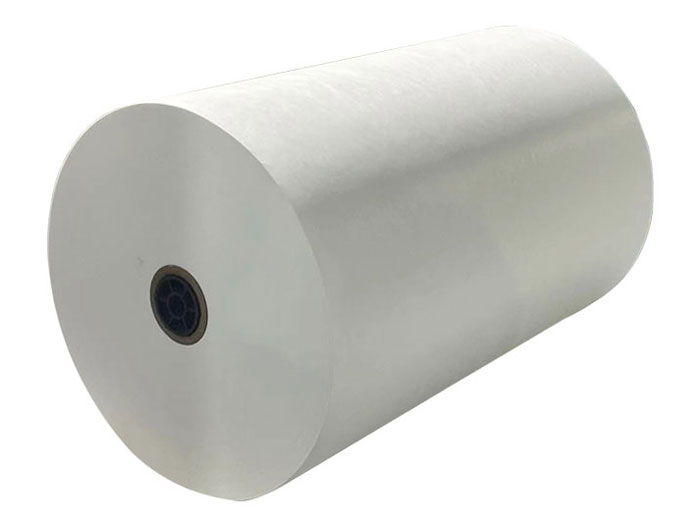
Why Wet-Laid Nonwoven Substrate Matters in RO Membrane Performance
In a reverse osmosis membrane, the visible separation performance is usually associated with the active polyamide layer. However, the support structure under the active layer is also very important. Wet-laid nonwoven materials provide mechanical strength, dimensional stability, and a uniform base for membrane coating.
For thin-film composite RO membranes, a stable nonwoven support helps the membrane maintain consistent performance during coating, curing, module rolling, and long-term operation. If the support layer is uneven, weak, or unstable, the final membrane may show defects such as poor coating uniformity, reduced pressure resistance, unstable flux, or increased risk of delamination.
| Performance Factor | Role of Wet-Laid Nonwoven Support | Impact on RO Membrane |
|---|---|---|
| Surface Uniformity | Provides a smooth and consistent base for coating. | Helps improve coating stability and reduce membrane defects. |
| Mechanical Strength | Supports the membrane during production, rolling, and operation. | Improves durability under pressure and handling stress. |
| Dimensional Stability | Reduces deformation during coating and thermal treatment. | Helps maintain stable membrane structure and performance. |
| Porosity and Flow Path | Creates a controlled support structure for water transport. | Supports balanced flux and reduces local flow resistance. |
| Chemical Compatibility | Must remain compatible with coating solutions and operating conditions. | Helps reduce swelling, separation, or long-term material failure. |
Wet-laid nonwoven supports are valued because they can offer more uniform fiber distribution compared with some conventional support materials. This uniformity is useful for producing a stable membrane substrate, especially when the coating layer must be thin, continuous, and defect-free.
For RO membrane manufacturers, the selection of the support layer should not be treated as a secondary decision. Basis weight, thickness, air permeability, tensile strength, thermal stability, and surface smoothness can all influence the final membrane quality.
In practical applications, a well-designed support layer helps the RO membrane achieve better consistency in salt rejection, water flux, pressure resistance, and service life. This is especially important for household water purifiers, commercial systems, industrial water treatment, and OEM/ODM membrane projects.
Yuhydro focuses on RO membrane products and water purification solutions for global partners. By paying attention to membrane structure, support materials, and application requirements, Yuhydro helps customers build more stable and reliable water treatment products.